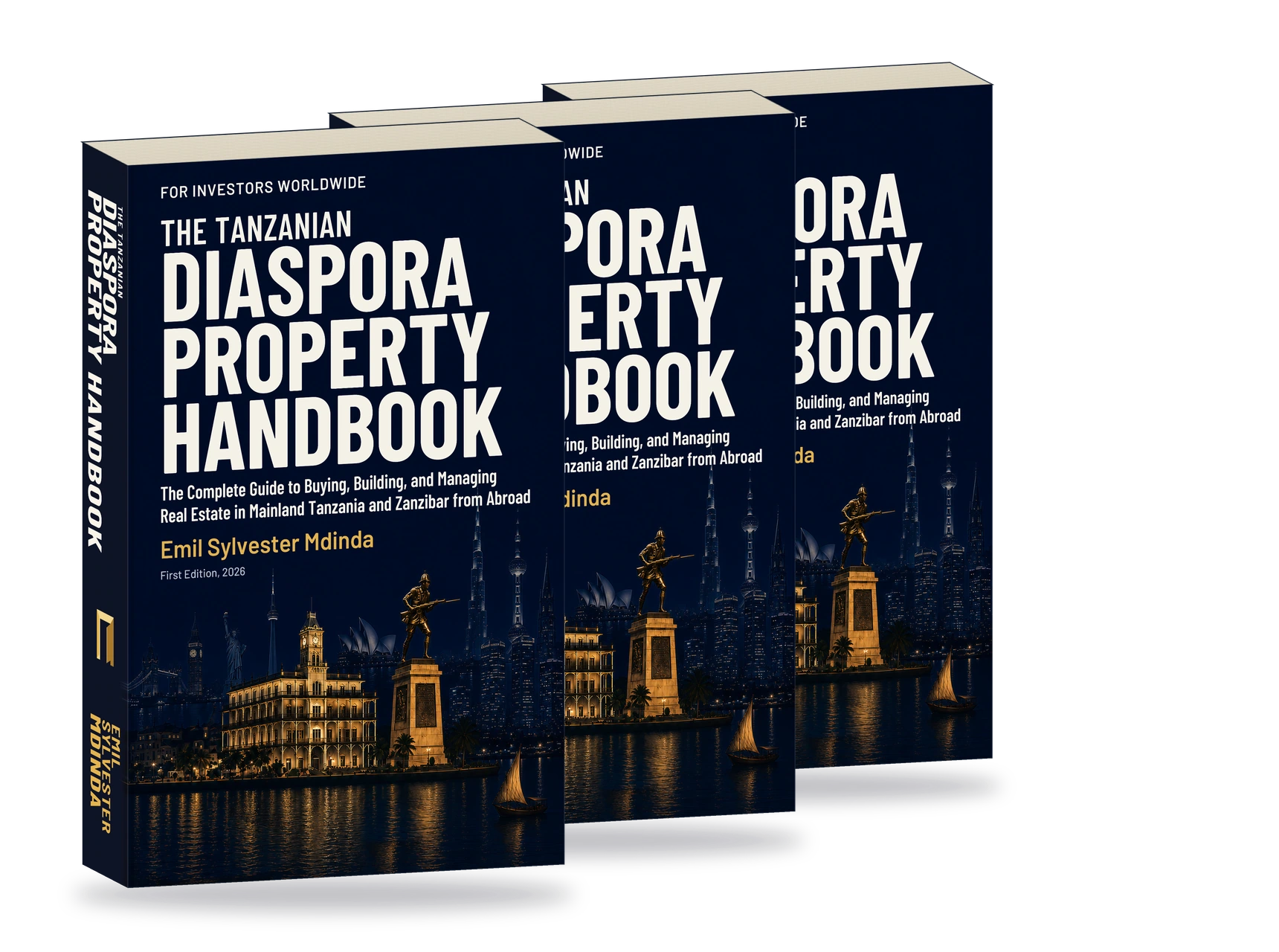
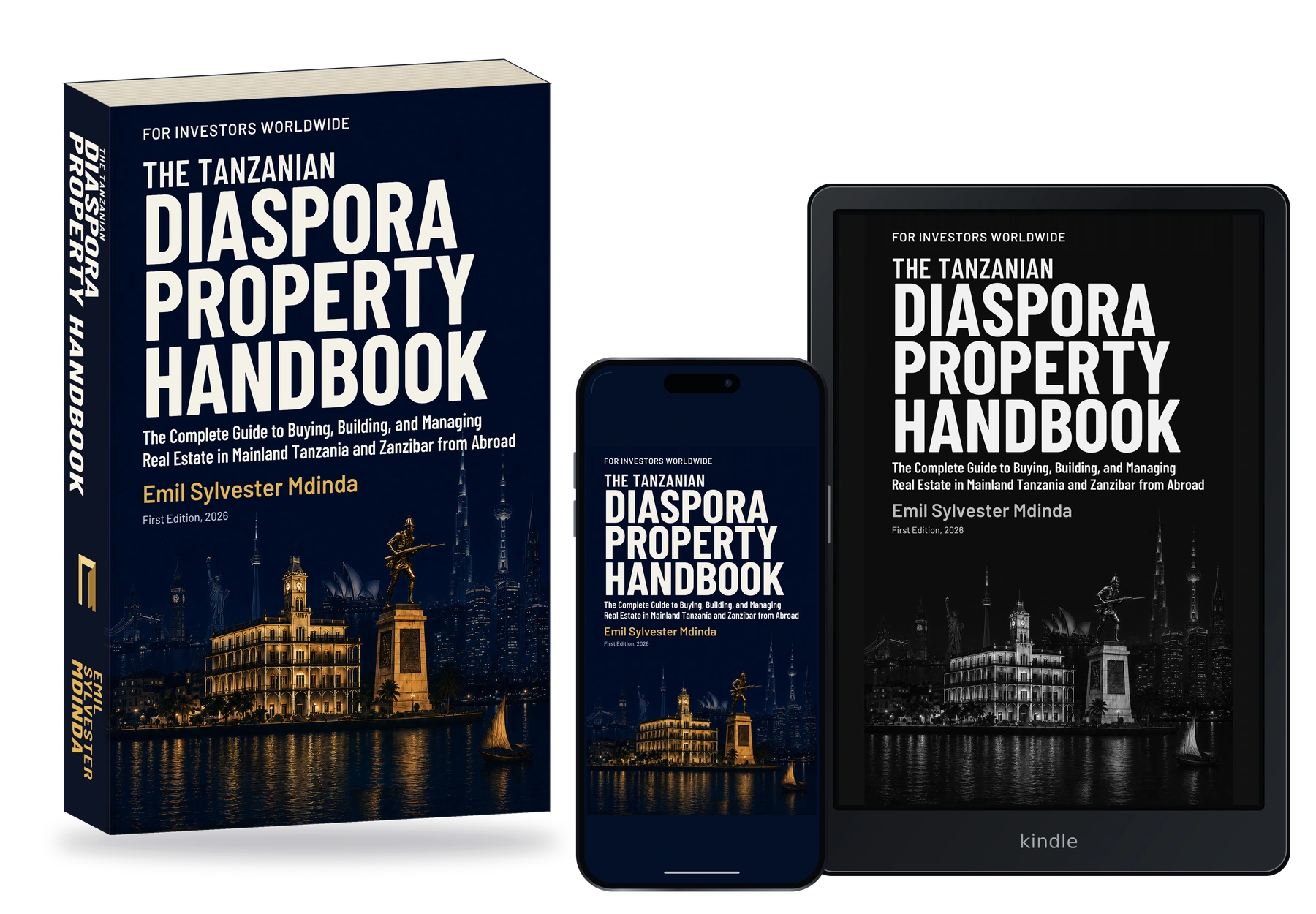
Before you send money home, build the system that protects it.
For the Tanzanian diaspora and international investors, wherever you live: the UK, USA, Canada, Australia, the Nordic countries, the Gulf, China, and beyond.
By Emil Sylvester Mdinda · Founder, Terranova Company Limited · First Edition, 2026
drag the book
Twelve years of fieldwork, distilled for the one moment that matters: just before the money moves.
12
Years of fieldwork, distilled
$1.27B
Sent home in FY2024/25, official figures
34
Chapters across six parts
536
Pages of straight answers
Akili ni mali.
Knowledge is wealth.
Why this book exists
Capital sent home is only as safe as the structures that receive it.
In 2024/25 the diaspora sent home about USD 1.27 billion through formal channels, up 57 percent in a single year. Too much of it is lost, not to weak markets but to unverified titles, informal purchases, and projects that stall the moment no one is watching.
It is not a motivational book, a wealth manifesto, or a promise of riches in three easy steps. It is twelve years of fieldwork written down: the questions investors actually asked, the problems we actually solved, the procedures worked out by walking them, often the hard way. In the corridors of the Ministry of Lands. In the courtyards of Stone Town. On building sites in Mbezi Beach, Masaki, and Kigamboni. In WhatsApp threads at three in the morning across five time zones.
It will not promise you wealth. It promises something smaller and truer: that if you read it carefully and use it well, you will avoid the expensive, preventable mistakes that have quietly emptied diaspora accounts in this market for a generation: the village land that could not pass to an outside buyer as it stood, the beachfront plot inside the setback that could not lawfully be built on. Every time, preventable. The information simply was not in front of the buyer in time. That information belongs in front of you before the money moves, and these pages put it there.
Usinunue mbuzi kwenye gunia.
Do not buy a goat in a sack.
A look at the book
Open the Book Before You Open the Deal.
An overview of the framework, the tone, and the discipline behind the handbook, quoted from the book but laid out for this site. The full book is designed to be used before the money moves: before the deposit, before the contractor, before the family agreement, before the title mistake becomes expensive.
The Complete Guide to Buying, Building, and Managing Real Estate in Mainland Tanzania and Zanzibar from Abroad.
Emil Sylvester Mdinda
FIRST EDITION · 2026
From the Preface
Written to change that.
Tanzanians living abroad have been making one of the most important financial decisions of their lives, investing in real estate back home, with incomplete information, conflicting advice, and no single trusted resource. This book was written to change that.
“Every checklist exists because someone, somewhere, skipped that step and paid for it.”
The Phase-Gate Map
The Diaspora Investment Lifecycle
01Market Intelligence and Capital Allocation
02The Acquisition Gate
03Development and Value Addition
04Operational Excellence
05Exit and Liquidity
Contents
Six parts, one journey
IFoundations, Strategy, and Diaspora Context
IILegal Readiness, Structures, and Rules
IIIBuying Safely
IVBuilding and Delivering Projects
VManaging, Protecting, and Growing the Asset
VIBigger Plays and Future-Facing Opportunities
Using it in the moment
Answer from the page.
When an agent presses for a fast deposit, a contractor asks for more money mid-build, or a relative proposes a joint project, do not answer from the moment.
“Most costly diaspora mistakes are made quickly, under emotional pressure, in the gap between a question and an answer. These pages are meant to fill that gap with something steadier than instinct.”
This is a serious book.
Get the full copy and the complete system, before the money moves.
“Do not answer from the moment. Answer from the page.”
From the Handbook
Usipoziba ufa, utajenga ukuta.
Seal a crack, or you will build a wall.
What's inside
One full system, built around the Diaspora Investment Lifecycle
Thirty-four chapters across six parts, following the real sequence of a Tanzania property investment, from first decision to safe exit. Most readers are in two or three phases at once.
PART I · CH 1 TO 4
Foundations, Strategy, and Diaspora Context
The home-first or Tanzania-first decision, what the diaspora already sends home, the words the market assumes you know, and the five priority markets.
PART II · CH 5 TO 11
Legal Readiness, Structures, and Rules
Who owns land and what you actually buy, entity structure, Zanzibar as a special case, power of attorney, budget reality, inheritance and succession, and the Tanzanite Card.
PART III · CH 12 TO 17
Buying Safely
Fraud patterns and protection, choosing location, title due diligence, working with agents and advocates, the ten steps of a purchase, and borrowing to build.
PART IV · CH 18 TO 23
Building and Delivering Projects
Whether to build, contractor or fundi teams, approvals and permits, managing construction remotely, the Remote Fundi Supervision System, and handover.
PART V · CH 24 TO 28
Managing, Protecting, and Growing the Asset
Property and short-term-rental management from abroad, the Diaspora Owner Dashboard, family and collective investment, and selling, exit and repatriation.
PART VI · CH 29 TO 34
Bigger Plays and Future-Facing Opportunities
Commercial and developer-scale projects, partnerships and platforms, importing standards, AI and remote oversight, funds and REITs, and the opportunity corridors of the next decade.
Plus nine working appendices: a glossary, an institutional directory, official and commercial web resources, money transfer and banking, key calculations, master checklists, sample forms and templates, benchmark data, and a treaty and title-protection guide. Built to be opened many times, not read once.
Haraka haraka haina baraka.
Too much haste has no blessing.
How to read it
A long weekend to read. A lifetime of decisions to use it for.
Read straight through, it is a serious commitment: a long weekend or two weeks of evenings. But it is not built to be read once at speed. Plan to read it at least twice. It is built to be read at the pace of your decisions.
01
Read it for the map
Go end to end, lightly, to see the whole journey and how the parts connect. Do not try to memorise anything yet.
02
Read it for your phase
Return to the part that matches where you actually are, slowly, with your own numbers and your own plot in front of you.
03
Read it in the moment
Before you buy, before you build, before you sign with family, before you sell, reopen the chapter that governs that step.
Asiyesafiri hajui mengi.
One who does not travel knows little.
Who it's for
The nurse with one plot, and the executive with a portfolio.
A book that serves only one end of that range fails the other. Each reader has a pathway through the chapters that fit their situation.
The first-time investorPart I in full, especially Chapters 1, 3 and 4. Then Part II, then Part III, which opens with the fraud chapter, before engaging any agent or developer.
Planning to buildParts II and III set your legal and financial foundation. Part IV is your construction guide; do not skip Chapters 21 to 23.
Managing remotelyPart V: Chapters 24, 25 and 26 cover property management, short-term rentals and the Diaspora Owner Dashboard.
STR & tourism-focusedChapters 7, 24, 25, 26 and 34, with Chapter 29 once you move into larger-scale hospitality.
Commercial & developer-scalePart VI from Chapter 29, with Chapter 30 on partnerships, Chapter 27 on collective investment and Chapter 33 on REITs.
Based in China or the Nordic countriesChapter 1 has dedicated subsections on sequencing, sourcing and documentation culture.
Kept your Tanzanian citizenshipThe Part II restrictions do not apply to you. Read the Introduction, then Chapters 5, 13 to 16, and Appendix I3.
Inherited a propertyGo straight to Chapter 10; it opens with the section written for heirs.
Kidole kimoja hakivunji chawa.
One finger alone cannot crush a louse.
EM
Emil Mdinda
About the author
Emil Sylvester Mdinda
Founder & Managing Director, Terranova Company Limited
Emil founded Terranova Company Limited in 2014, a real estate advisory and property-management firm he has built over more than a decade of practice across Mainland Tanzania, Zanzibar, and North America. He holds a BSc in Property and Facilities Management from Ardhi University and is currently studying for a Master of Sustainability (M.Ss.) in Regenerative Sustainability at the University of Saskatchewan (USask), in the School of Environment and Sustainability. He has worked across agency, valuation, facilities management, development advisory, and cross-border structuring, which is why the handbook treats a title search and a maintenance budget as parts of the same problem.
He has held advisory mandates with national pension funds, banking authorities, and government institutions, and has guided hundreds of diaspora and domestic transactions, from single plots to multi-unit developments. His research interests include diaspora investment, fractional ownership through special-purpose vehicles, and sustainability in the built environment.
“My life in real estate did not begin with a transaction, a title deed, or a balance sheet. It began with buildings, and with noticing them.” The book is dedicated to his late father, Sylvester Mdinda Joseph Shija, valuer and Dar es Salaam City Land Officer, whose old property market notes reshaped his understanding of how Tanzania’s markets have evolved since the 1980s.
M.Ss. student, Regenerative Sustainability, USaskAssociate Member, IREM (CPM candidate)Member, IFMAMember, U.S. Green Building CouncilGreenbuild 2026 Peer ReviewerPeer Reviewer, AfRESBetween Tanzania and Saskatoon, Canada
Earlier chapters of the same career: creating one of Tanzania’s first real estate television programmes, and organising the Bunge Property Expo, the first real estate exhibition held at Tanzania’s National Parliament.
From the Author’s Note
“The most ruinous errors in this market were, every time, preventable. The information simply was not in front of the buyer in time. That information belongs in front of you before the money moves, and these pages put it there.”
Wholesale pricing is available for bookstores, libraries, universities, professional bodies, banks, diaspora associations, and institutions placing bulk orders within Tanzania. Tell us the quantity and we will send rates and delivery options.
Receive occasional book updates and practical resources for investing in Tanzania, including new editions and the occasional tool or resource for diaspora investors in between. No noise.